Anti-Aging, Opti-Aging, Regenerative Aging: Maybe We’ve Been Asking the Wrong Question
Something interesting is happening among women my age.
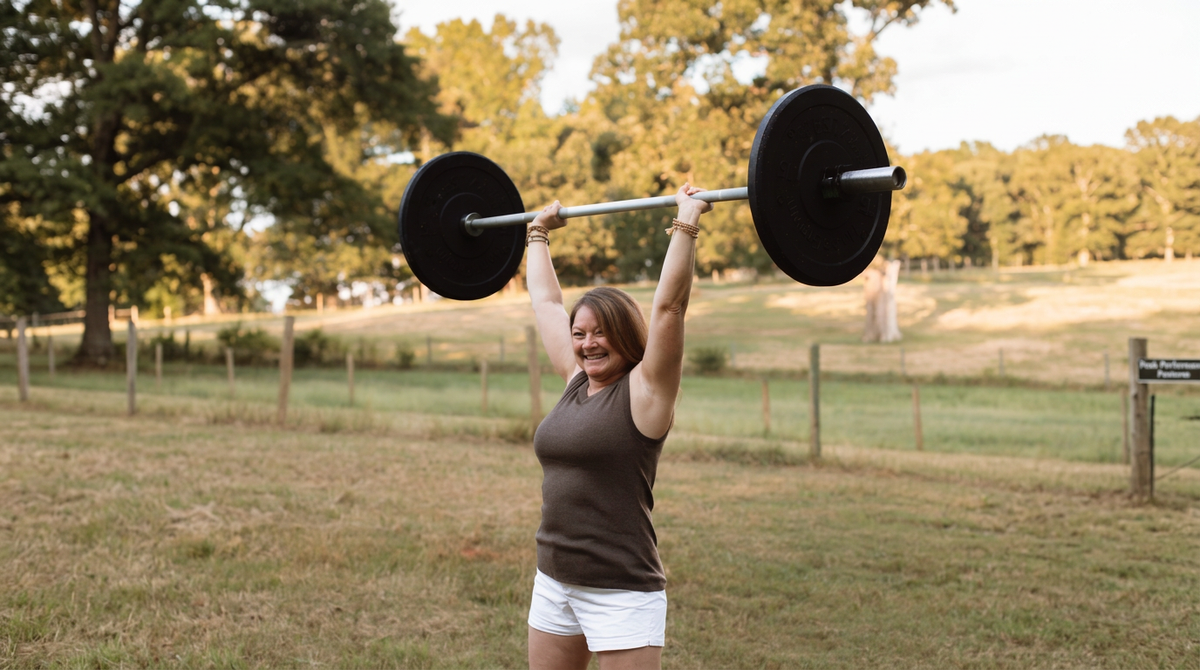
We're lifting weights.
We're talking about protein.
We're learning words like creatine and peptides and discovering that apparently we should have been paying attention to muscle mass all along.
We're walking more. Sleeping more intentionally. Thinking about bone density. Questioning things we accepted as inevitable. Having conversations about menopause that our mothers' generation rarely had out loud.
We're not giving up.
Quite the opposite.
But I think many of us are also becoming increasingly uninterested in fighting our age.
And that leaves us in a curious place.
Because for most of our lives, the beauty industry gave us only one direction to go:
Anti.
Anti-aging.
Anti-wrinkle.
Anti-sagging.
Anti-every-visible-indication-that-you-have-managed-to-remain-alive.
I'm not particularly interested in being anti-me anymore.
Opti-aging was a much better idea.
I was delighted when the conversation began shifting from anti-aging to opti-aging.
Instead of asking:
How do I stop getting older?
we started asking:
How well can I live as I get older?
That's a very different question.
It's the difference between trying to make a 58-year-old body behave like a 28-year-old one and asking what a 58-year-old body needs to be strong, capable, energetic and healthy.
So we pick up the weights.
We eat the protein.
We learn about changing hormones.
We protect our bones.
We build muscle instead of accepting its loss as inevitable.
We become active participants in our own aging.
I love all of that.
But lately I've been wondering whether there's another idea that belongs alongside opti-aging.
One I've actually been practicing for years without realizing it.
Regeneration.
Regeneration isn't reversal.
I'm a regenerative farmer.
And one of the things farming has taught me is that regeneration doesn't mean going backward.
When we work to regenerate a pasture, we're not trying to return it to some mythical moment when it was perfect.
Twenty years later, well-cared-for soil isn't merely older soil. It can be deeper, richer, more biologically alive and more resilient than it was in its “youth.”
We're now asking:
What does this living system need now?
Does the soil need more protection?
Do the plants need more recovery time?
Would greater diversity help?
Are we taking too much and returning too little?
How can we support the system so that it functions better and becomes more resilient over time?
We observe.
We respond.
We support.
And importantly, we work with the system we have—not the one we wish we still had.
One day it occurred to me:
What if we thought about aging that way, too?
What if your face isn't a renovation project?
I have sun damage.
I have fine lines.
My skin is thinner than it used to be.
Gravity and I are now very well acquainted.
None of this is particularly surprising.
I'm in my late 50s.
I've also spent decades outside, raised a family, built businesses, worked a farm, cared for animals and accumulated some wonderful adventures.
My skin kept the receipts.
For years, though, women have been taught to look at every one of those changes as something requiring correction.
A wrinkle appears.
Attack it.
Texture changes.
Resurface it.
Skin becomes thinner and more sensitive.
Add another active.
Something sags.
Lift it.
Something creases.
Fill it.
Now, I want to be clear about something.
There is absolutely nothing wrong with wanting to look good.
I certainly do.
Use your peptides.
Use your retinoid if your skin loves it.
Have the treatment.
Color your hair—or don't.
Wear makeup—or don't.
Do whatever makes you feel most like yourself.
This isn't another set of rules women have to follow correctly.
We've had enough of those.
What I'm questioning is the assumption underneath so much of it:
That aging itself represents failure.
My skin doesn't need to be younger to be better.
That's something I've come to understand through my own skin.
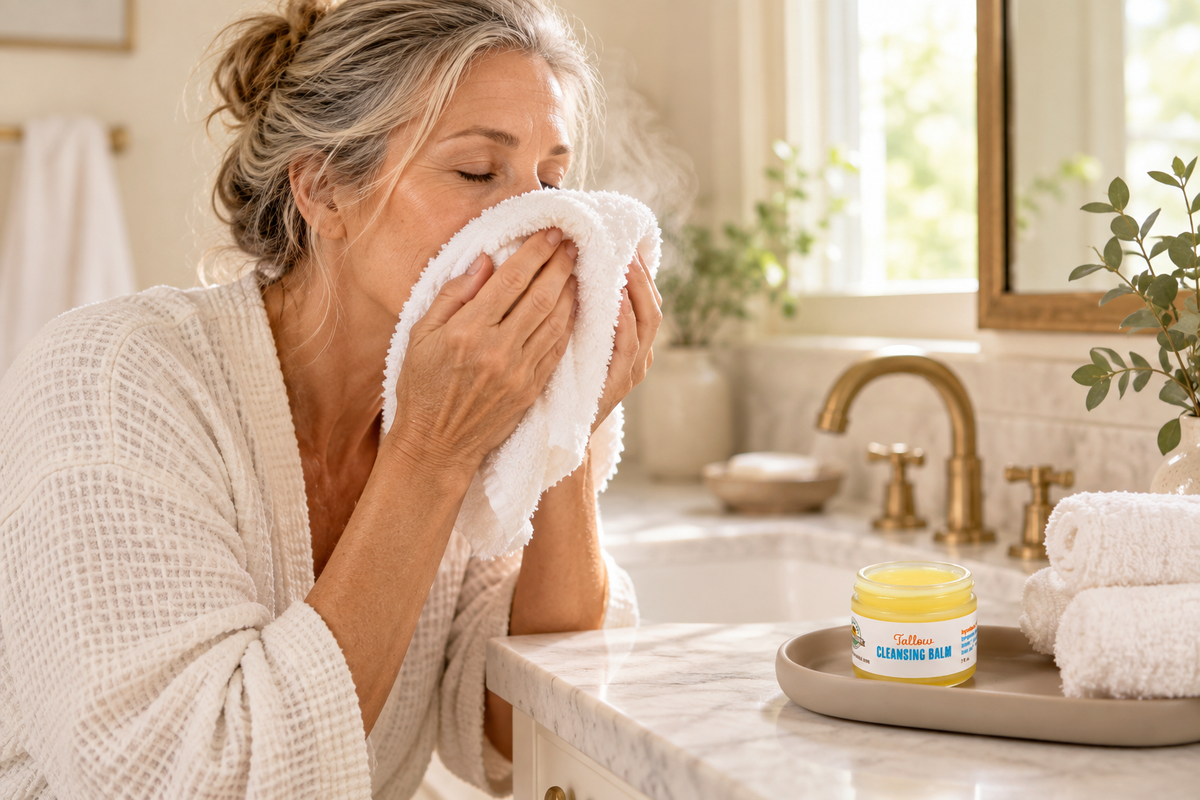
I've been using tallow on my face for more than thirteen years.
And today, despite being older, I genuinely think my skin is doing better than it was years ago.
Not younger.
Better.
Those are not the same thing.
It feels comfortable.
Supple.
Cushioned.
Resilient.
Radiant.
It doesn't feel like something I need to constantly fix.
And that distinction has completely changed the way I think about skincare.
I don't formulate for a woman trying desperately to recover the face she had at 30.
I formulate for the woman she is now.
Aging skin has different needs.
This isn't merely philosophical.
Skin actually changes with age.
Its thickness changes.
Sebum production changes.
Its ability to hold water changes.
Barrier function can change.
Collagen and elasticity change.
And menopause introduces another profound biological transition.
So why would we expect the skincare that worked beautifully at 30 to necessarily be what our skin wants at 55?
Sometimes the answer may be a sophisticated active.
And sometimes the answer may simply be:
Stop taking so much away and give the skin more support.
That's where my own interest in lipids has deepened.
Aging skin doesn't simply become "thirsty."
Changes in the skin barrier and its lipids can contribute to dryness, sensitivity and increased water loss.
Which means mature skin may benefit tremendously from something decidedly unglamorous:
Fat.
Good, thoughtfully chosen, beautifully formulated fat.
Not because fat makes us younger.
Because lipids can help soften, cushion and protect skin that increasingly appreciates all three.
And honestly?
That's plenty.
Maybe opti-aging and regenerative aging belong together.
I don't think we need to choose.
Opti-aging asks:
What can I strengthen?
Build the muscle.
Support the bones.
Learn about the hormones.
Use the peptide.
Stay curious.
Keep growing.
A regenerative mindset asks:
What can I support?
Protect what's functioning well.
Replenish what's becoming depleted.
Respect recovery.
Work with the living system rather than constantly fighting it.
Accept that resilience sometimes comes from adding support—not adding pressure.
One is active.
The other is restorative.
We probably need both.
Stronger doesn't have to mean harder.
This may be one of the great revelations of this stage of life.
At least it has been for me.
I can become physically stronger while becoming gentler with myself.
I can lift heavier weights and stop criticizing my thighs.
I can learn about peptides and still love the lines around my eyes.
I can care deeply about my skin without needing to erase its history.
I can want to look wonderful without pretending I'm not getting older.
Those ideas aren't contradictory.
They're maturity.
Maybe the goal isn't to surrender to aging.
And maybe it isn't to defeat aging either.
Maybe it's to become increasingly skilled at living inside a changing body.
The farm keeps teaching me this.
Nothing here stays the same.
Pastures move through seasons.
Animals age.
Weather rearranges our plans.
Soil responds slowly.
Some years are abundant.
Others ask more from us.
Regenerative farming requires attention because yesterday's answer isn't necessarily today's answer.
So does caring for ourselves.
What worked at 35 may not work at 55.
That's not failure.
That's information.
Listen.
Observe.
Adjust.
Support.
Keep going.
Perhaps we've been asking the wrong question.
For decades we asked:
How can I stop looking older?
Then we got smarter and began asking:
How can I age optimally?
I think there's room for one more:
How can I support the woman I'm becoming?
Her muscles.
Her bones.
Her mind.
Her energy.
Her skin.
Her ambitions.
Her curiosity.
Her peace.
Not because we're trying to regenerate ourselves into younger women.
We're not.
Regeneration isn't reversal.
It's caring for a living system well enough that it has what it needs for the season it's in.
That's what I try to do with my land.
That's what I've learned to do with my skin.
And increasingly, it's how I want to approach the rest of my life.
I don't want to spend the next thirty years fighting the evidence that I'm fortunate enough to still be here.
I want to be strong.
I want to be curious.
I want to feel good.
I want healthy, radiant skin.
I want to keep learning.
I want to keep becoming.
And if a few wrinkles come along for the ride?
They know where to find me.
— Shalley