
When Clean Doesn’t Feel Comfortable: A Gentler Way to Wash Aging Skin
If your face feels tight after cleansing, it may not be especially clean. It may simply be asking you to ease up.
For years, I thought a freshly washed face was supposed to feel unmistakably washed.
A little tight. Quite bare. Perhaps even faintly squeaky—as though one’s face were a casserole dish requiring proof that all grease had been removed.
My skin has since revised that opinion.
In my late 50s, I no longer judge a cleanser by how thoroughly it announces its work. I care much more about what my skin feels like ten minutes later: comfortable, soft, and ready for the next step—or dry, prickly, and already requesting assistance.
Cleansing is supposed to remove what does not need to remain on the skin. It does not need to remove every trace of comfort along with it.
Aging skin may have less tolerance for an enthusiastic scrub
Skin commonly becomes drier during and after menopause. As estrogen declines, changes in the skin’s ability to retain water and its collagen can leave it feeling thinner and drier. Some women also find their skin becomes more easily irritated.
That means a cleansing routine that worked perfectly well at 35 may feel unnecessarily aggressive now.
The American Academy of Dermatology recommends washing menopausal skin with a mild cleanser rather than soap, which can be too drying. Its face-washing guidance also advises using lukewarm water, applying cleanser with the fingertips, avoiding scrubbing, and gently patting the skin dry.
None of this is very glamorous.
It is, however, refreshingly useful.
Tightness is not the goal
A cleanser needs enough cleansing power to remove the day: sunscreen, makeup, sweat, soil, and whatever the Georgia breeze has thoughtfully deposited on my face while I am outside with the buffalo.
But cleansing is a balancing act.
The skin’s protective barrier relies on water and lipids. Harsh cleansing and vigorous rubbing can leave dry skin feeling tighter and more irritated. Choosing lukewarm water and a gentle technique is a useful place to start.
A good cleanse should leave your face feeling clean—but still recognizably like skin.
If you immediately feel desperate to cover it with something rich, your cleanser or technique may be doing more than you need.
Where a cleansing balm can help
A cleansing balm offers a different experience from a foaming cleanser.
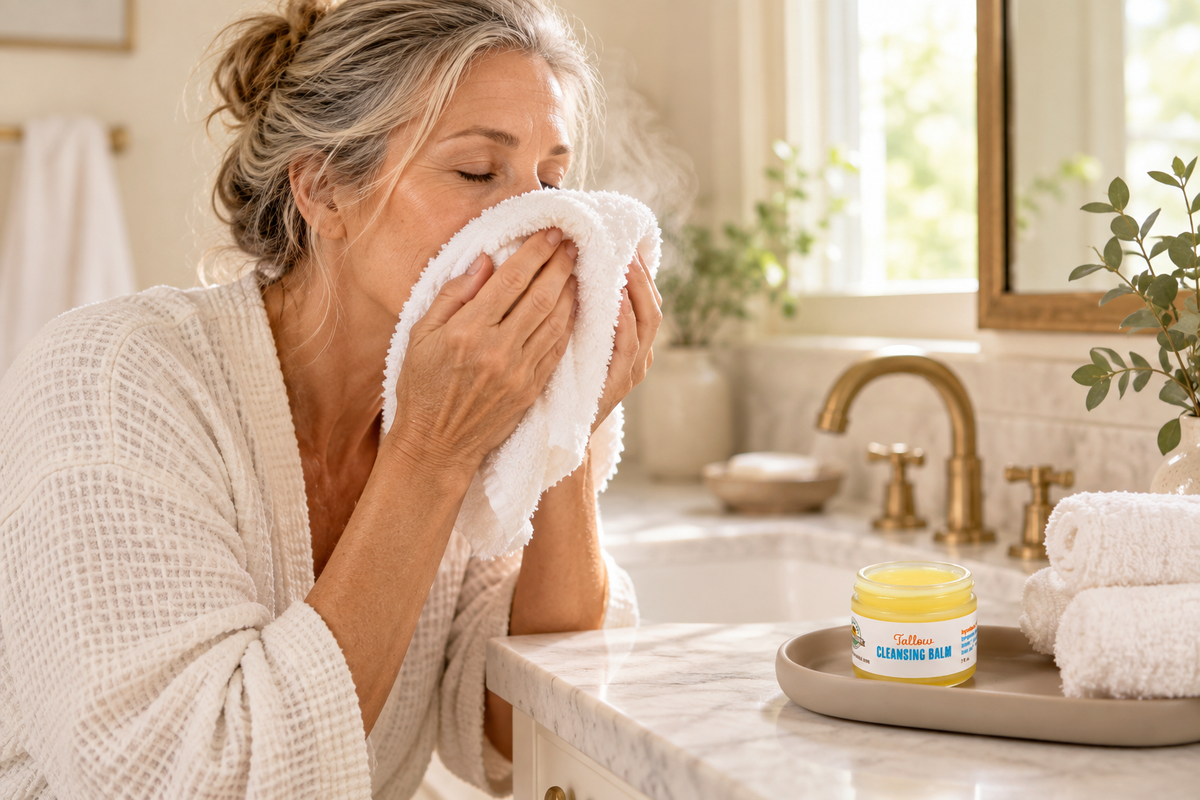
Instead of creating a large lather, it is massaged over dry skin to loosen makeup, sunscreen, surface oils, and the day’s general accumulation. It can then be removed according to its directions, often with a soft, warm, damp cloth.
For women whose skin has become drier or less tolerant of foaming products, that richer method may feel more comfortable. It also encourages slower, gentler handling of the skin—although one can certainly turn a washcloth into a power tool if sufficiently determined.
The important word is gentle.
The cloth should be comfortably warm, not hot enough to steam your face into submission. Press and lift rather than scouring. Around the eyes, use an especially light touch and follow the product’s directions for eye-area use.
Oil cleansing is not a requirement for aging well. It is simply one option—and, like every skincare method, it must suit the skin using it.
Do you need to double cleanse?
Not necessarily.
Double cleansing generally means using an oil-based cleanser first, followed by a second water-based cleanser. It can be useful when you are wearing substantial makeup or a tenacious sunscreen, but it is not an achievement badge.
If one thorough, gentle cleanse removes what you need it to remove and leaves your skin comfortable, a second round may offer more ceremony than benefit.
On lighter days, some women may need very little cleanser at all in the morning. A rinse with lukewarm water may be sufficient, depending on your skin, your evening products, and what feels comfortable.
Your routine is allowed to respond to the day you actually had.
A simple balm-cleansing practice
If you are trying a cleansing balm, begin simply:
-
Start with dry hands and a dry face.
Use the amount recommended for your particular product. -
Massage gently.
Move your fingertips slowly over the skin without dragging or scrubbing. Give the balm time to loosen makeup and sunscreen. -
Use a soft, warm, damp cloth.
Hold it briefly against the face, then wipe gently. Repeat with a clean section of the cloth as needed. -
Check the result.
If residue remains or you wore heavier makeup, follow with a mild second cleanser. If your skin already feels clean and comfortable, you may be finished. -
Follow with hydration and lipid support.
Apply your water-based products and moisturizer while the skin still retains a little dampness. If your skin enjoys a balm afterward, use only as much as it needs.
The entire process should feel pleasant. Burning, persistent stinging, rash, or worsening irritation is not evidence that your pores are being purified—or that you should persevere out of loyalty to natural skincare. Stop using the product and seek professional advice if irritation continues.
Clean enough is beautifully sufficient
I am increasingly fond of skincare that knows when to stop.
Cleansing does not have to strip, polish, resurface, or discipline your face. Its job is to clear away what has accumulated while respecting the skin underneath.
That may mean a mild cream cleanser. It may mean a cleansing balm and a warm cloth. It may mean using less product, cooler water, and kinder hands than you did ten years ago.
Your skin has carried you through another day.
You can send the day down the drain without trying to send your skin’s entire protective layer with it.
Clean. Comfortable. Still yours.
That is enough.


