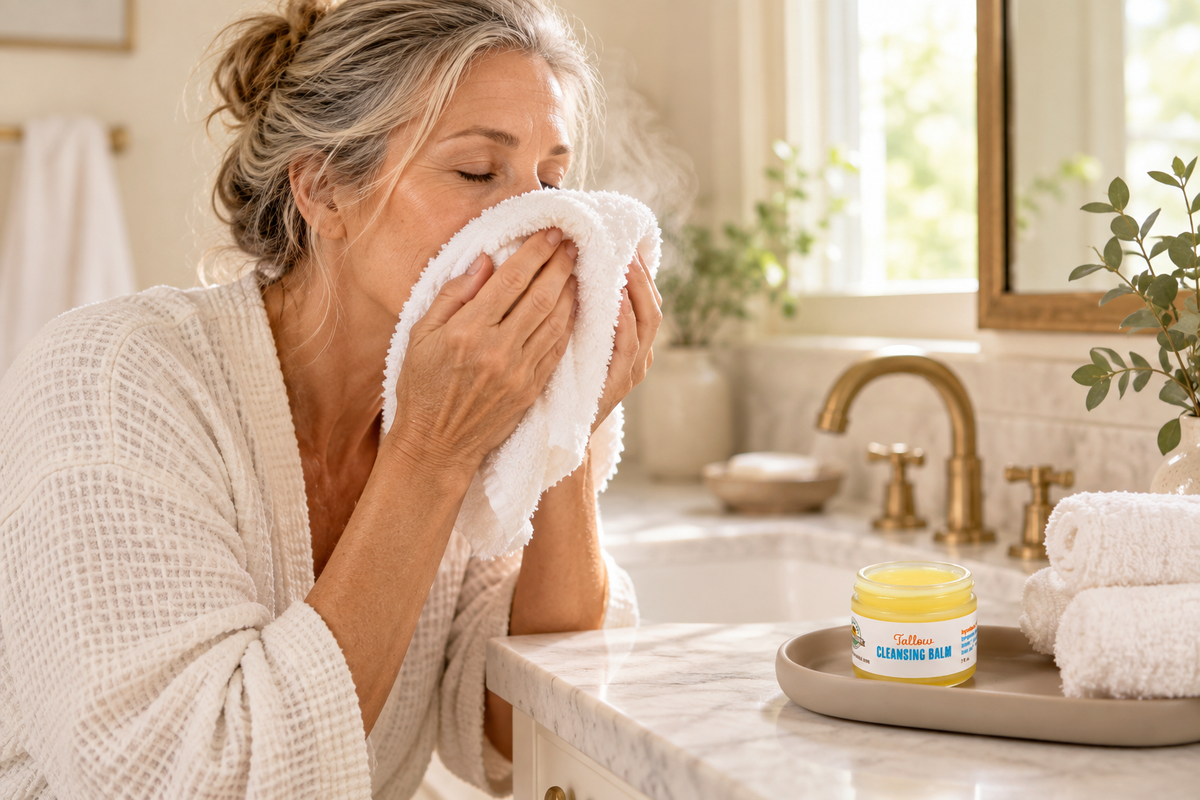
Your Skin’s Fall Transition: When Aging Skin Begins Asking for More
There is often a week in early fall when your skin notices the season before you do.
The mornings feel a little cooler. The air conditioner is still running in the afternoon, but perhaps the heat comes on for the first time overnight. Suddenly, the face balm that felt like plenty in August disappears a little too quickly. Your cheeks feel tight after cleansing. Makeup settles differently. The comfortable, cushiony feeling you had grown used to seems harder to hold onto.
Your skin is not being difficult. And it has not somehow aged overnight.
It may simply be responding to a change in its surroundings—and asking for a little more support.
Fall is not just a wardrobe change
As outdoor temperatures and humidity begin to fall, we also start spending more time in heated indoor air. These changes can affect how well the outermost layer of skin holds water and performs its barrier work.
Research has found that low humidity and lower temperatures can reduce skin-barrier function and make skin more vulnerable to stress. Even short exposure to heated indoor winter conditions has been associated with measurable changes in hydration, roughness and transepidermal water loss—the quiet escape of water through the skin.
That does not mean the first crisp morning is a dermatological emergency. It simply helps explain why a routine that felt perfectly adequate in summer may begin to feel a bit skimpy in fall.
Aging skin may feel the shift more clearly
Our skin changes throughout life. With age—and, for many women, the hormonal changes surrounding menopause—it may produce less sebum, recover more slowly from environmental stress and feel less naturally cushioned than it once did.
That can make seasonal transitions more noticeable. You may experience:
- tightness after cleansing;
- rough or papery-feeling patches;
- greater sensitivity to products you normally tolerate;
- a sudden desire to apply moisturizer again by mid-afternoon; or
- fine lines that look more pronounced when the skin is temporarily dry.
None of this means your skin has failed. It means the conditions have changed, and your care may need to change with them.
I am in my late 50s, and this is one of the lessons my own skin has taught me repeatedly: consistency matters, but rigidity does not. Good skincare is not about forcing the same routine through every season. It is about paying attention.
Moisture and lipids do different jobs
We often use the word moisturizer as though every moisturizing product works in the same way. It does not.
Water and water-binding ingredients help increase hydration. Emollients soften the surface and fill some of the tiny spaces between shedding skin cells. More occlusive ingredients help slow the evaporation of water from the surface.
Healthy skin depends on all of this working together. Its outer layer is sometimes compared to a brick wall: the flattened skin cells are the bricks, while an organized mixture of lipids—including ceramides, cholesterol and fatty acids—helps form the mortar around them.
Topical tallow is not identical to that native lipid mixture, and it is not a replacement for every component of the skin barrier. That distinction matters. But a thoughtfully formulated tallow product can serve as a rich emollient and occlusive layer, helping soften the skin and reduce the rapid loss of water from its surface.
In other words: adding water is useful. Helping the skin keep it is useful, too.
Before you buy anything new, adjust the routine you have
The beauty industry has trained us to greet every seasonal change with a shopping list. Your skin may need something much simpler.
1. Cleanse with a lighter hand
If your face feels tight immediately after washing, take that as information. Try lukewarm rather than hot water. Use a gentle cleanser, and consider whether your morning skin truly needs a full cleanse or simply a rinse.
Clean skin should not have to squeak to prove itself.
2. Apply hydration to slightly damp skin
A water-based serum, lotion or glazing milk can help bring hydration to the surface. Applying it while the skin is still slightly damp can make the layering process feel more comfortable.
3. Follow with a lipid-rich layer
Once you have added hydration, a balm or richer cream can help soften the skin and slow water loss. You may need only a small amount. Warm it between your fingertips and press it gently into the areas asking for more support.
4. Increase richness before increasing complexity
Fall may not be the best moment to introduce several strong actives at once—especially if your skin is already feeling unsettled. Sometimes the wiser adjustment is simply a gentler cleanse, a little more hydration and a more protective finishing layer.
5. Let your skin set the schedule
Some women need a richer layer only at night. Others appreciate it morning and evening once the heat comes on. Skin is living tissue, not a calendar. Let comfort, texture and response guide you.
Where our water-buffalo tallow fits
At Buffalo Gal Grassfed Beauty®, we work with tallow from the 100% grassfed water buffalo raised on our regenerative family farm in Monroe, Georgia.
We gently dry render this tallow without a salt-water washing process, then use it as part of intentionally formulated skincare for aging skin. We call our approach structural lipid support—not because tallow is identical to human sebum or because it performs miracles, but because its fatty-acid-rich character makes it a useful, deeply cushioning ingredient in the right formula.
For fall, I often think in layers:
- Apply Tallow + Peptide Glazing Milk to bring lightweight hydration and supportive ingredients to the skin.
- Follow with a small amount of Tallow Face Balm to soften and help hold that hydration close.
- Adjust the amount by feel. A little more on cool, dry evenings; a little less on warm Georgia afternoons that have apparently forgotten the season changed.
You do not have to use both products, and tallow will not suit every person. The point is to understand what each layer contributes so you can make a thoughtful choice for the skin you have now.
A seasonal transition, not a skin crisis
Autumn invites us to notice small changes: the pasture slowing, the angle of the light shifting, the first dry leaves gathering along the fence line.
Skin has seasons, too.
If yours begins to feel less supple or comfortable this fall, you do not need to declare war on it. Begin gently. Add hydration. Protect what you have added with a lipid-rich layer. Change one thing at a time, then pay attention.
No miracle promises. No fear of getting older. Just thoughtful care for skin that has carried you through many seasons already.
Explore regenerative skincare for aging skin at buffalogalgrassfed.com.